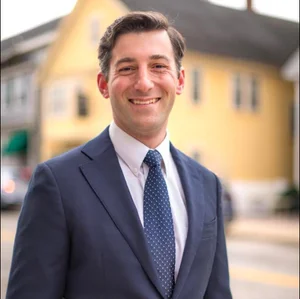
Jewish Journal: HONORABLE MENSCHION - State Representative Simon Cataldo
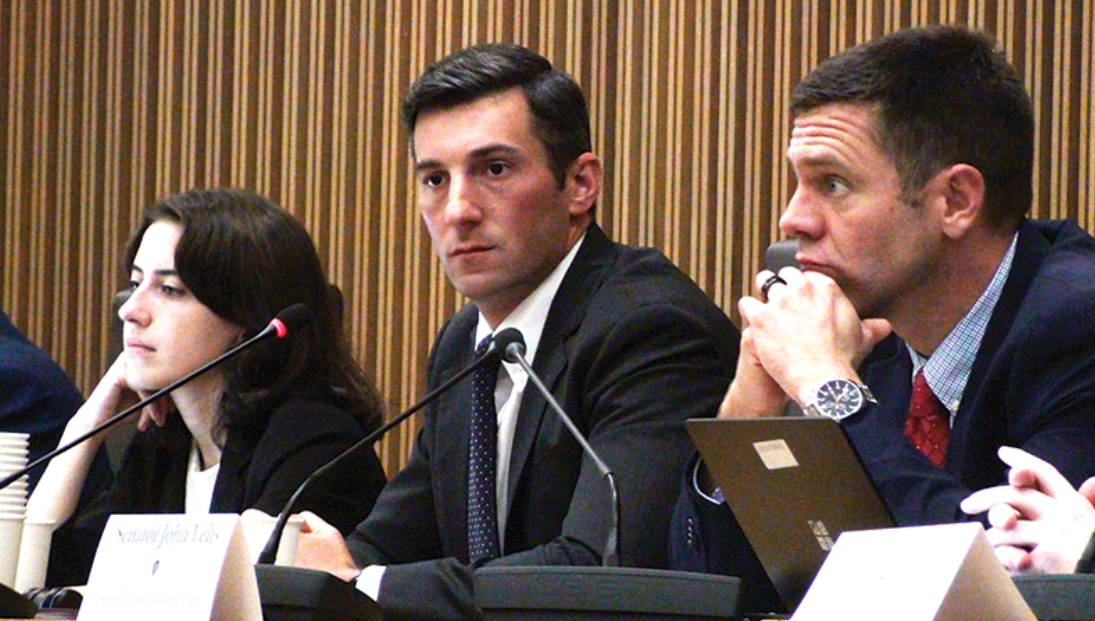
Simon Cataldo, center, served as co-chair of the state’s Special Commission on Combating Antisemitism./BRETT M. RHYNE
Simon Cataldo grew up in West Concord and had his bar mitzvah at the Kerem Shalom synagogue in the town. He went to Colorado College, taught special education math at Harlem’s Frederick Douglass Academy and later founded Harlem Lacrosse, a national nonprofit.
He went on to earn his law degree from the University of Virginia; joined the U.S. Department of Justice’s Honors Program, and prosecuted public corruption in the Public Integrity Section as a trial attorney. In 2022, he was elected state representative for the town of Carlisle and parts of Acton, Chelmsford, and Concord. As co-chair of the state’s Special Commission on Combating Antisemitism, Cataldo led a series of hearings last year at the State House that resulted in dozens of recommendations to help prevent antisemitism in the state. He lives in Concord with his wife, Chessie, and four children.
Simon, tell us about your family, your parents, siblings, where you grew up and your Jewish upbringing.
I live in my hometown of Concord with my wife, Chessie, and our four children. My mom (Carol) and dad (Jim) raised my sisters Eva and Anna here. My mom was Jewish and my dad is not, but we were raised in an unapologetically Jewish household. That’s thanks largely to my dad, who decided to cast his lot with the Jewish people. I went to Hebrew school and had my bar mitzvah at Kerem Shalom synagogue in Concord, where I’m still an active congregant.
You went to Colorado College, studied environmental science and then taught special education math at Harlem’s Frederick Douglass Academy through Teach for America. You also started Harlem’s first public middle school lacrosse team, and later founded Harlem Lacrosse, a national nonprofit. What did you learn from those experiences?
Teaching in Harlem and starting Harlem Lacrosse was the most formative experience of my life outside of my family and my faith. My mom’s first jobs as a social worker were in Brooklyn and the Bronx, so I guess I came by that type of work honestly. For the first few months in Harlem, my classroom was chaotic and at times physically unsafe. Lacrosse is what saved me. When I formed the team, my students immediately started to respect my classroom, do their work, and develop a sense of internal pride. They fell in love with the sport, and through that experience we did some pretty amazing things together in the classroom and on the field. And we took no mercy on the private schools once they finally agreed to play us.
You earned your law degree from the University of Virginia, joined the U.S. Department of Justice’s Honors Program, and prosecuted public corruption in the Public Integrity Section as a trial attorney. Justice seems to be a major theme in your life.
I had an incredible opportunity to work under the leadership of and alongside supremely talented prosecutors who lacked a political/partisan cell in their bodies. We sought and achieved justice in cases against many public officials who breached the public trust and broke the law. I prosecuted righteous cases during both the Obama and first Trump administrations. Unfortunately, the Public Integrity Section has essentially been disbanded by the second iteration of the Trump Justice Department. For the sake of our safety and the rule of law, Americans should hope that many of the public servants who have been purged from the Justice Department make their way back in future Democratic and Republican administrations.
You’re the state representative for the town of Carlisle and parts of Acton, Chelmsford, and Concord. Why did you decide to go into politics and become an elected official?
I made the decision on a whim when I read in a blog one morning, during the throes of the COVID-19 pandemic, that my state rep was running for higher office. I was solely working in private practice at the time and missed public service, but had zero political experience and few relevant network connections. If I had known then how brutal it would be to campaign in a competitive Democratic primary, I might not have done it. Fortunately for me, by the time I found out, it was too late to quit.
Now that I have the job, I love it more than I ever anticipated and will not let it go easily. Three years in, I still get butterflies in my stomach every time I walk into the House chamber.
You served as co-chair of the state’s Special Commission on Combating Antisemitism. What can you tell us about antisemitism in Massachusetts?
Two things can be true at once. I think many of our ancestors would barely sneeze at what we’re going through now. At the same time, the golden age of post-World War II Jewish safety and acceptance is clearly over. It’s been understandably hard for most of us to grapple with that second part. Antisemitism has become socially acceptable again in many schools, workplaces, and among some political subgroups. Jews are more likely to be the victim of hate crimes in Massachusetts than any other minority, despite our population being only a fraction of other groups. The biggest difference from other states is that we’re trying to tackle the problem head-on. The state’s special commission is the beginning, not the culmination, of that work.
As co-chair, you led numerous hearings where people testified about antisemitism across the state. Did anything about the process surprise you?
It’s one thing to see the statistics and it’s another entirely to hear testimony directly from people, especially young people, who have experienced antisemitism. One detail that stuck out to me again and again was the number of students who stopped wearing or tucked in their Star of David necklaces while around other students. Like most people, I was also surprised that the president of the Massachusetts Teachers Association, in his remarks before the special commission, exhibited no contrition for the antisemitic curriculum materials that the union distributed to its members, although they did later take some of them off their website.
The most surprising thing, however, was the unflinching support we received from most of our state’s political leaders. Given the outright opposition and gaslighting from well-organized far left groups about our work, I thought some of our high profile elected officials might find it too politically perilous to publicly support our recommendations. That wasn’t the case. Both U.S. senators, the mayor of Boston, House Minority Whip Katherine Clark, Congresswoman Lori Trahan, Congressman Seth Moulton, Congressman Jake Auchincloss, and many others publicly endorsed the report. The governor, lieutenant governor, A.G., and of course the House speaker and Senate president have all been steadfast, consistently pushing us to go farther. This was critical to our success.
What can you tell us about Jewish children and antisemitism in public schools?
I think we’re in an uncomfortable stage where families and many staff/teachers are less willing to sweep incidents under the rug, which of course exposes shortcomings in our schools’ ways of handling these matters, but also creates robust opportunities for improvement. The special commission report provides a detailed playbook for actionable steps that school districts can and should take. Many school committees and administrators around the state are implementing these recommendations, and we see that change happening quickly.
Where does the state go from here in navigating discrimination in areas like K-12 schools, higher education, law enforcement and public safety, and workplace settings, including health care?
The special commission report lays out a path forward in the form of 84 findings and specific recommendations that touch upon each of these areas. I strongly encourage residents to read the report and identify the practical, achievable steps that can be taken in their communities. The success of our collective efforts to protect Jews and enable us to thrive will rely principally on the grassroots work of people in our communities.
Would you like to run for higher office?
I love the job I have. It’s a great position for a dad and husband with four young children, and I feel I’m making a significant impact on major policy issues. I’ve been able to move important legislation through the House, including an evidence-based literacy bill that was my top priority bill this session, as well as environmental legislation revising Massport’s charter and economic development legislation for the former MCI Concord prison property. There’s a lot of room for me to grow in the House.
What do you love about being Jewish?
Being Jewish is the greatest gift that my parents gave me. In a way it’s hard to describe how you “love” something that is so intrinsic and indispensable to who you are. I think the part I treasure the most about being Jewish is that it gives my life purpose. As a Jew, I’m part of a spiritual tradition and heritage that requires continuity through family formation, religious observance, and tikkun olam.